Simplified visual design for a library feature to let patrons suggest books for purchase.
summary
- BYU Library has a feature for letting users suggest new books for the library to purchase
- Library wanted to redesign the user input form for this “Suggest a Book” Feature
- Through conversations with stakeholders and user input, I revamped the form to be more user-friendly while still meeting stakeholder needs

project requirements
The BYU Library wanted to its feature to let patrons suggest books for the library to purchase. The existing form worked, but patrons often did not include all the information that librarians would need to find that book quickly, leading to extra time being spent trying to find the book. I was asked to redesign the form to better help both librarians and users.
Design process
iteration 1: initial Suggest a Book form

Methods
- Stakeholder interviews
- Talked to stakeholders to see what information they absolutely needed from the form
- User interviews
- Asked people how many fields they would be willing to fill out for a form like this
- Asked people what they thought a feature like this would be for
Feedback
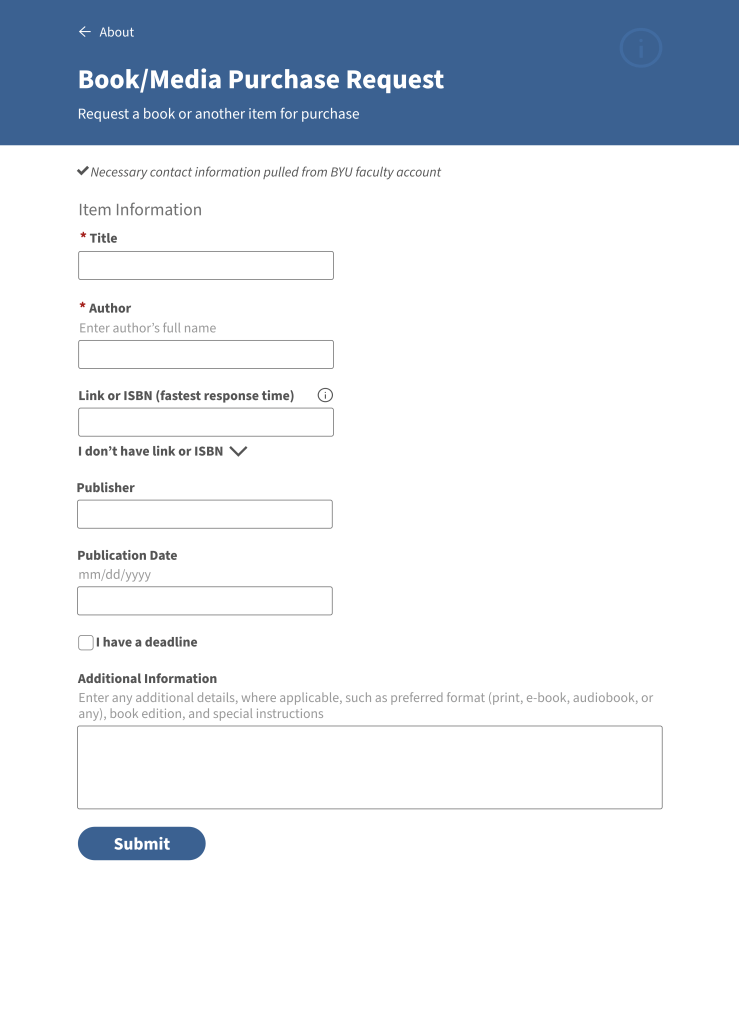
- The only fields that stakeholders needed were the title, the author, and the link to the book. If patrons did not have a link, they could provide additional information.
- There was no set number of fields that users were willing to fill out. They told me that the fewer fields the form had, the better.
- The name “Suggest a Book” did not communicate to users what the form was actually for. After talking with library staff, we found that the term “Book/Media Purchase Request” was standard for other libraries. After showing this name to users, they were able to accurately describe what the feature is based on its name.
Iteration 2: condensed form
results
Based on information from users and stakeholders, I was able to adapt the form so that it had fewer fields, but still required all the information from users that stakeholders needed. Although the final product does not look drastically different visually, it led to a smoother experience for patrons and librarians. The name change also allowed patrons to more quickly find and understand the form. Sometimes, a redesign does not need to be dramatic to make a positive impact.
 Chase Kimball